
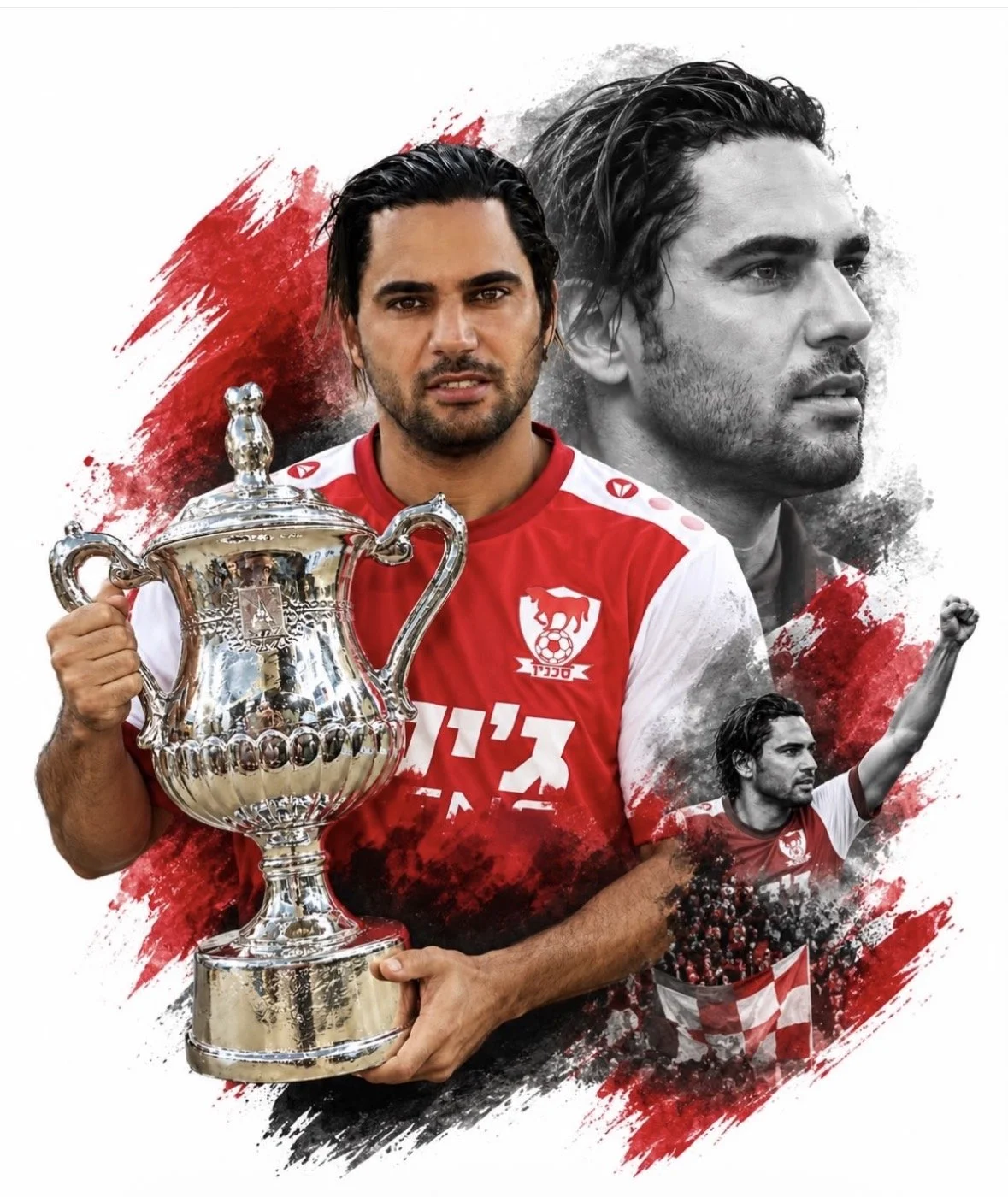
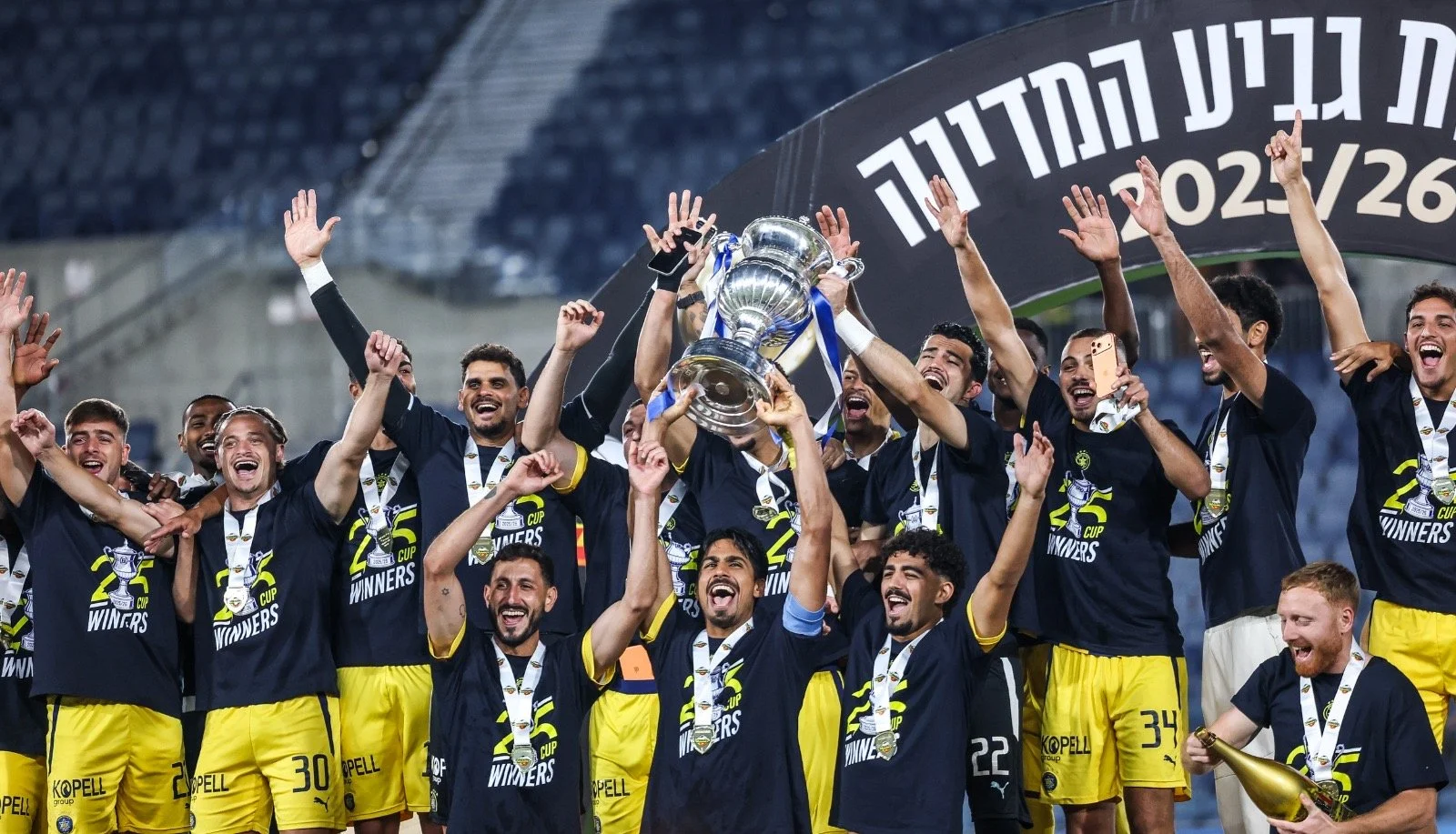
The State Cup that Bnei Sakhnin won in 2004 was a rare, historic event in Israeli football.
It was the first, and so far the only, title won by an Arab club in our football, achieved through wonderful joint work between Arabs and Jews. To this day, the story symbolises the power and diversity of Israeli football, an almost unique arena where Arabs and Jews live side by side and play on a fully meritocratic basis, with real sporting equality. One of the players who was the face of that season and of that Cup was the late Lior Asulin, who this year, three years ago, was murdered at the Nova festival on October 7, 2023.
This evening at 17:00, at the Doha Stadium in Sakhnin, a ceremony and a special match will be held in his memory, at the club’s initiative. Asulin’s family will attend, along with a series of players and legends from the great 2004 Cup-winning team. The match pits members of that team, coached by the man who managed Sakhnin at the time, Eyal Lahman, against Sakhnin’s current senior squad, coached by Yossi Abuksis.
There will be a minute of silence with applause, and the match will kick off at 17:15, with Abbas Suan, Kamoko Kamara, Ernest Atchi and Gabriel Lima taking the field. Public figures and schoolchildren from the village and the surrounding area have been invited. “The aim is to remember, and to remind people of, the late Lior’s commitment to the club, which greatly strengthened the belief in the power of sport to connect people,” the club said in a statement ahead of the match.
The event comes after criticism heard more than once in recent years that Sakhnin had not done enough to commemorate the player who was the star of that season, having scored twice in the final in a 4-1 victory over Hapoel Haifa.
“Lior was a senior and significant partner in the club’s historic achievement, he was very much loved, and everyone who was at the club at the time has only good memories of him,” Bnei Sakhnin told BabaGol. “The club holds great respect for the late Lior and for his family, who asked for a dignified and fitting ceremony, and that is exactly what it will be.”
The event signals winds of change at Sakhnin this season. But first, to understand its meaning and its importance within Israeli football culture, one has to understand who Lior Asulin was, as a player and as a person.
A Player Who Embodied Real Israeli Football
Asulin was never an international, and he did not star for clubs like Maccabi Tel Aviv or Maccabi Haifa. He grew up at Maccabi Herzliya and passed through Maccabi Petah Tikva before arriving at Sakhnin. There he knew a legendary year, as noted, and moved on to Beitar Jerusalem, where he also shone and became a fan favorite. He went on to play for Bnei Yehuda, Hapoel Tel Aviv and Hapoel Be’er Sheva in the Premier League, had a brief spell in Cyprus, and played for a string of clubs in the second tier and the lower leagues. From conversations with players who played alongside him and coaches who worked with him, the impression is that Asulin was a real guy and a real footballer. Not a star with airs, but someone who loved the game at whatever level he played it. In many ways he was Israeli football in its truest form: the one who comes from below and surprises and moves you. A bit like that friend you played with in the neighborhood as kids, who years later turned out to have made the dream come true, and whom you talk about proudly at Friday dinner. Asulin did exactly that, and in a big way. Even as a veteran, he looked after and took care of the younger players, as Omer Atzili, who played with him at Hapoel Rishon LeZion and stayed in close touch with him over the years, has often testified.
Over his career, Asulin scored around 180 goals, many of them beautiful ones. Real football goals. Because, once again, Asulin was a real person, and that is why he was also a real footballer. His approach to the game was a positive one, about fun: putting a smile on the faces of the fans and his teammates, and celebrating goals. Friends say he was the same in life, which did not always take him to good places, and yet in spite of everything, in his final years he coached children, giving them from his experience and his mistakes, and guiding them.
Paying Respects in a Complicated Reality
Since October 7, 2023, many clubs in Israeli football have paid their respects to Asulin in different ways. Abroad, too, magazines and media outlets marked his death, recalling Sakhnin’s Cup triumph and the small club’s short UEFA Cup run the following season, with its famous two-legged tie against Newcastle United.
There was something moving, innocent and historic in the connection between Asulin and Sakhnin. It was a different version of Israeli football as we know it today, something softer, and in many ways a symbol of a different Israel. Jews, Arabs, Muslims and Christians giving everything on the pitch together, playing shoulder to shoulder, achieving something huge, making history for a village in the north and placing it at the front of the European football stage.
Still, as noted, over the past two years there has been harsh criticism of Sakhnin for not properly expressing condolences for their former player, who was murdered by Hamas after coming to the party to celebrate his 43rd birthday, which fell on October 6.
On several occasions, family members spoke about the matter in the media and said the club had sent no representatives to the funeral and had not come to the shiva. The club did publish a statement expressing sorrow on social media in the days after the murder, but held no public gesture of solidarity, and it was evident that this pained Asulin’s family very much.
“Over the past two years we were surprised and disappointed that no representative of the club came to Lior’s funeral or the shiva,” Ortal Asulin, Lior’s sister, tells BabaGol. “But a week ago they contacted us and explained that they wanted to hold a dignified event, to be broadcast on television, and we consulted within the family. We wondered whether the anthem would be played and whether there would be a condemnation of the acts, and we had many questions, but the conversation with the spokesman and the new owner (Khaled Duchy) surprised us very pleasantly, and we decided to come and take part,” she explains.
Not all of the family will attend, as some are still hurt, but for Ortal it matters. “Anywhere they mention my brother, I will be there,” she says. “I know that if Lior, who always saw the good in people, had seen this initiative, he would have supported it and would have wanted us to take part.”
The family did want to make sure that no political figures would take part in the event, and that the ceremony and match would not be turned into a show tied to the election season. Indeed, several political figures who had been planning to attend, among them Mazen Ghnaim, who was Sakhnin’s chairman during the Cup season, will not take an active part in the ceremony.
At the club, the family explains, they were very attentive to the family and its requests regarding the event, and that is what led them to agree to take part.
A New Sakhnin?
The initiative to organize the match and ceremony reflects a major change that Bnei Sakhnin went through this past summer. After fourteen years, some of them very stormy, particularly in the relationship between the club and the media and the wider public, chairman Mohammad Abu Younis, who did a great deal for the team, left. The last few years were especially hard. Since October 7, there have been several incidents that clouded relations between the club and its fans and the rest of the Israeli football community, sometimes not their fault at all and sometimes with them as full partners. These included incidents in which the crowd did not respect the anthem, the incident with Be’er Sheva fans at Turner Stadium, and the team’s announcer, who was accused of collaborating with the enemy over an interview with a channel identified with Hezbollah in Lebanon. Together they created a very negative picture.
The reality in which Sakhnin has existed for years as the only Arab club in the top flight repeatedly confronts it with sensitive and highly complex challenges in how it addresses the different audiences within Arab society in Israel and the wider public. In times of war, this was even harder. The demand and expectation from Jewish society that the club condemn and speak out, in ways that did not always align with the identity of the society it represents, created gaps and rifts between Sakhnin and Israeli football. A change in management approach and public image was called for.
The man who stepped into Abu Younis’s shoes is Khaled Duchy, who served as CEO and board member for years, and so far things look different. People around him tell BabaGol that there is a thought and a desire to bring Sakhnin back to the identity the club had in the past, and Duchy saw that the time and the moment had come for a meaningful gesture for one of its legends. It is not only the match in Asulin’s memory. During the most recent Sukkot holiday, the team visited Kibbutz Hannaton, with the players and coach Abuksis meeting a rabbi at the synagogue and children from the kibbutz. “Sakhnin is part of Israeli society, and it represents the place of Arab society in Israel and in Israeli society at large,” the club says. “Positive social action is important precisely at this time, and the event in Asulin’s memory is part of that.”
Better Late Than Never
The 2004 Cup that Asulin won with Sakhnin was the peak of Lior Asulin’s career as a footballer. It was an occasion in which he served as the central hero: the hero of a great football story in our history, and a story about Israel as it was then, or as many would like it to be today and in the future.
So why is this match happening now? Perhaps it is the new management. Perhaps it is also the expectation and demand from elements in Israeli football that Sakhnin “condemn” and “take a side,” which put pressure on the club to express solidarity or hold such an act. And perhaps it is simply because of the complexity of life and existence in Israel under the shadow of a hard war, as we have been living in recent years. It may also be a combination of all of these factors. The truth? For people at the club, it matters less. “Whoever wants to reduce polarization in Israeli society will view the event positively. Whoever immediately asks ‘but why now?’ will probably always look for the flaw.”
Some three years after he was murdered, Lior Asulin will receive great honor from the club to which he gave truly epic, historic sporting moments. “This is not closing a circle, because there is no circle. A person’s memory must always be honored,” they say in Sakhnin.
It would have been good had such an event happened earlier, but now is better than never. Especially at this time, when Israeli society is divided and tense, at a decisive crossroads over the future of this place, the ceremony and match in Asulin’s memory can offer a taste of a future and a reality that we have almost forgotten we deserve: to experience and live cross-sector, cross-origin cooperation, in simple solidarity that is not necessarily political but human, with football holding it all together.
This article was first published on Haaretz.









Houthi attacks on Saudi Arabia put the January 2027 Asian Cup in doubt, with a delay to 2028 or a move to Qatar discussed behind the scenes.