
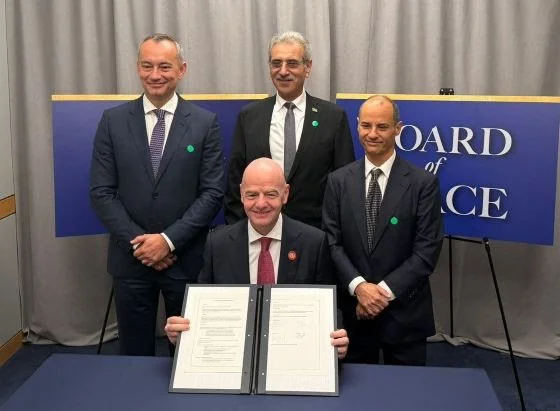
FIFA published overnight the agreement signed between the organisation and the Board of Peace regarding its involvement in the rehabilitation of Gaza.
The agreement presents the use of football as a tool for recovery, stability and long-term development in conflict zones in general – and in its first phase, in Gaza.
The agreement was signed by FIFA President Gianni Infantino, Board of Peace executive member for Gaza Yakir Gabay, the High Representative for Gaza on behalf of the Board of Peace, Nickolay Mladenov, and the Chief Commissioner of the National Committee for the Administration of Gaza, Dr Ali Shaath. The ceremony was held at the headquarters of the Donald J. Trump U.S. Institute of Peace.
The Board of Peace was unveiled by Donald Trump at the World Economic Forum in January 2026 as a body bringing together international leaders and institutions to promote reconstruction and stabilisation in vulnerable regions. Its initial focus: Gaza. Its stated objective: coordinating humanitarian aid, reconstruction efforts and a long-term stabilisation process.
Infantino described the agreement as a “historic partnership that will encourage investment in football to support recovery processes in post-conflict areas.” Behind the grand language lies a detailed, almost engineering-style work plan aimed at building a complete football ecosystem:
50 mini-pitches near schools and residential neighbourhoods
Five full-size regulation pitches across several districts
An advanced FIFA Academy
A new 20,000-seat national stadium
Alongside infrastructure, the programme emphasises job creation, workforce training, organised leagues for girls and boys, community engagement and the stimulation of local commercial activity.
Implementation of the agreement is divided into four clear phases:
Phase One – Community activation (3–6 months):
Installation of 50 mini-pitches, launch of the Football for Schools programme, distribution of equipment and structured grassroots activities.
Phase Two – Professional infrastructure (12 months):
Development of five full-size pitches and the establishment of local clubs to create structured pathways for competitive football.
Phase Three – FIFA Academy (18–36 months):
A centre of excellence integrating elite sport, education and accommodation, with an emphasis on talent identification and professional employment opportunities.
Phase Four – National stadium (18–36 months):
Construction of a 20,000-seat stadium for sporting and cultural events, serving as a national venue, generating revenue and acting as a community anchor.
According to FIFA officials speaking to Israel Hayom, everything will proceed in line with ongoing monitoring of safety and security conditions on the ground. In other words: the ball will start rolling only when reality allows it. When will that be? It remains unclear.
What is clear is that this move forms part of a broader trend. At the Summit for Peace in Sharm El-Sheikh in October 2025, FIFA reaffirmed its commitment to contribute to international peace efforts wherever possible.
Can football truly serve as an engine for civilian recovery, and is FIFA the right body to implement such a vision? History offers examples both supporting and questioning that premise. Based on the initial report published yesterday in BabaGol and the plan FIFA released overnight for Gaza, if and when the initiative is implemented, it will represent a real test of the claim that FIFA and Infantino often repeat: that the beautiful game can help create a better world.
In Gaza, however, it will not depend on football alone — and it will be interesting to see how, and whether, the project ultimately materialises.